
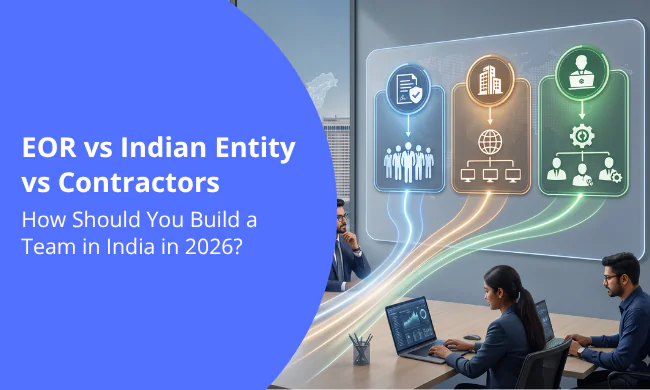
Global companies building teams in India generally consider three models: using an Employer of Record, engaging independent contractors or establishing an Indian legal entity. Each can be appropriate, but they solve different business problems and carry different levels of cost, control and compliance responsibility.
Employer of Record services in India are often well suited to companies that want to employ people without immediately incorporating. Contractors may be appropriate for genuinely independent, project-based work. An Indian entity can make more sense when a company has a long-term local strategy, substantial headcount or revenue-generating operations in India.
This guide compares the three models so HR, finance, legal and business leaders can identify the questions they should answer before hiring.
Choose an EOR when you need employees in India but are not ready to establish an entity. Use contractors only when the relationship is genuinely independent. Consider an Indian entity when the operation is large, permanent, locally managed or involved in selling and contracting in India. The right answer depends on substance, not the label used in an agreement.
When Should a Company Use an Employer of Record in India?
An EOR is generally useful when a company needs genuine employees but does not want to establish and operate an Indian entity immediately.
Common situations include:
- Hiring the first few employees in India
- Testing Indian talent or operating strategy
- Building an engineering, product, finance or support team
- Employing a candidate quickly while evaluating incorporation
- Transitioning workers from an unsuitable contractor arrangement
- Supporting employees in multiple Indian states
- Maintaining a smaller long-term team without local sales activity
Under the EOR model, the EOR signs the employment contract and takes responsibility for local payroll and statutory employment administration. The client selects the employee and directs the person’s work.
This structure can reduce administrative complexity, but it does not make corporate tax, intellectual property, data protection or permanent establishment questions disappear. Those risks must be evaluated based on the company’s actual activities in India.
When Is an EOR Not the Right Option?
An EOR should not be treated as a permanent workaround for every form of Indian business activity.
An owned entity may deserve serious consideration when the company plans to:
- Sell directly to Indian customers
- Sign local customer or supplier contracts
- Receive or book India-sourced revenue
- Maintain premises under its own control
- Build a large and enduring workforce
- Appoint local leaders with broad commercial authority
- Apply for licences or participate in regulated activities
- Make substantial long-term investments in India
An EOR partner should be willing to say when its model is not suitable. A provider that presents EOR as eliminating every legal or tax risk is oversimplifying the decision.
When Are Independent Contractors Appropriate?
Contractors are appropriate when the person is operating an independent business and controls how services are delivered. Typical examples include a specialist completing a defined project, an agency serving multiple clients or a consultant engaged for a limited outcome.
A contractor arrangement becomes higher risk when the individual:
- Works exclusively or almost exclusively for one company
- Follows fixed employee-style hours
- Reports to a company manager like an employee
- Requires permission to take leave
- Uses only company tools and systems
- Performs an ongoing core business role
- Has little control over the manner of work
- Receives a fixed monthly amount resembling a salary
- Is prevented from serving other clients
Calling someone a “consultant” does not determine legal status. Authorities and courts may examine the real working relationship. If the company needs to control the person like an employee, an EOR or owned entity is usually the more defensible model.
How Do the Models Compare on Cost?
There is no universal headcount at which one model becomes cheaper. The answer depends on salaries, benefits, EOR fees, professional advisers, office needs, finance operations, regulatory filings and the internal time required to manage an entity.
EOR cost structure
An EOR invoice generally includes employee compensation, employer-side statutory costs, benefits or reimbursements and the provider’s service fee or markup. Buyers should confirm whether setup, deposits, termination assistance, hiring and special reporting cost extra.
Contractor cost structure
Contractors normally invoice an agreed fee. The apparent cost may be lower because employee benefits and payroll administration are not included. However, a misclassified relationship can create tax, employment and dispute exposure that is not reflected in the invoice.
Indian entity cost structure
An entity incurs incorporation and ongoing operating costs. These may include legal, tax, accounting, payroll, statutory filings, banking, governance, insurance, local leadership and internal administration. Per-employee costs may become more efficient at scale, but the business assumes direct responsibility for the operation.
Instead of relying on a generic break-even number, model the total cost over at least 24 to 36 months under realistic hiring scenarios.
| Cost category | EOR | Contractors | Indian entity |
|---|---|---|---|
| Incorporation | No client entity required | Usually not required | Yes |
| Monthly provider or admin fees | Yes | Usually no EOR fee | Payroll and professional-service costs |
| Statutory employment costs | Included or passed through where applicable | Not normally treated as employment costs | Paid directly by entity |
| Internal compliance workload | Lower | Moderate | Higher |
| Exit administration | Managed with EOR involvement | Governed by services contract | Managed directly by entity |
| Misclassification exposure | Low if employment is correctly administered | Can be significant | Low for correctly employed workers |
Which Model Is Fastest for Hiring?
Contractor onboarding can be fast when the arrangement is genuinely independent and the agreement is straightforward. An EOR can also onboard employees more quickly than establishing a fully operational entity because the EOR already has local employment infrastructure.
Entity setup generally takes longer because incorporation is only one step. The company may also need banking, tax registrations, payroll, employment templates, benefit programs, accounting processes and local governance.
Do not publish or rely on a universal promise such as “hire within 48 hours.” Timelines depend on background checks, documentation, notice periods, payroll cutoffs, role requirements and employee responsiveness.
A Simple Decision Framework
Choose an EOR when:
- You need employees rather than independent service providers.
- You do not have an Indian entity.
- You want to test or begin an India hiring strategy.
- You value faster setup and reduced internal administration.
- Your intended activities fit within an EOR structure.
Choose contractors when:
- The work is defined and independently delivered.
- The provider controls how and when the work is performed.
- The relationship is not managed like employment.
- The contract accurately reflects the operating reality.
Consider an Indian entity when:
- India is a permanent strategic operation.
- You expect substantial or sustained headcount.
- You need direct local commercial activity or premises.
- You are prepared to manage governance, tax and employment obligations.
- Direct control and long-term investment justify the additional administration.
How 97 Tech Center Can Help
97 Tech Center provides Employer of Record services in India for global businesses that want to build compliant India-based teams without immediately opening a local entity. Through our registered Mumbai entity, we support employment, payroll, statutory administration, hiring, onboarding, offboarding and workforce reporting for talent across India.
Our engineering and technical-team experience also informs how we approach intellectual-property assignment, confidentiality, access controls and replacement hiring. We can discuss your intended roles, employee locations and expansion plans to help determine whether an EOR engagement fits your current stage.
An EOR is not the right structure for every business. Where your plans require direct local selling, contract authority or a permanent operating entity, obtain independent legal and tax advice before proceeding.
Frequently Asked Questions
Is an EOR better than establishing a company in India?
An EOR can be better for faster or lower-administration hiring when a foreign company does not need its own Indian operation. An entity may be better for substantial, permanent or revenue-generating activity. The choice depends on headcount, duration, control, cost and tax considerations.
Is hiring contractors cheaper than using an EOR in India?
Contractor fees may appear lower because employment benefits and EOR administration are not included. However, contractors are suitable only for genuinely independent relationships. Misclassification exposure can outweigh the apparent saving.
Can an EOR prevent permanent establishment in India?
An EOR can reduce some common risk factors, but it cannot guarantee that permanent establishment will not arise. Contract authority, business activities, duration, workplace control and the applicable tax treaty must be evaluated independently.
Who manages an employee hired through an EOR?
The EOR is the legal employer and manages the formal employment relationship. The client company normally selects the employee and directs everyday duties, goals, training and performance, subject to the agreed legal and operational boundaries.
When should a company move from an EOR to its own Indian entity?
Review the structure when India becomes a permanent market, headcount grows substantially, local commercial authority is required or an owned operation provides better strategic and financial value. There is no single threshold suitable for every company.
Editorial and Legal Review Note
This guide provides general information and is not legal, tax or accounting advice. Worker classification, permanent establishment, intellectual property and employment obligations depend on the facts and applicable law.